

Shopify Editions Spring 2026 Recap
 Shopify Editions Spring 2026 Recap
Table of Contents
Today, a new edition of Shopify was released: Shopify Editions Spring 2026.
In this release, more than 150 new features were introduced under the headings of Agentic, Sidekick, Online, Retail, Marketing, Operations, Shop app, Payments, Finance, and Developer.
Agentic
The most striking and exciting feature of this release was the Agentic channel, which recently started appearing in some stores under Sales Channels.
Shopify automatically lists the products in your store on AI channels. With the Agentic dashboard, you can track your performance and sales on these next-generation channels, and easily identify what is missing in your product data to increase conversion rates with the help of dynamic guides.
** Google AI and Gemini support are currently available only to US-based stores and stores selling to the US market. Microsoft Copilot is similarly limited to stores selling to the US market for now. Shopify will expand support for these agents to more countries and markets in the coming months.
Structured Product Data for AI Agents
Shopify Catalog automatically standardizes and enriches your product data into a format that AI agents can read most accurately. This structured data, distributed and optimized by the Shopify infrastructure, provides 2 times more conversion in traffic coming through AI chats.
Direct Checkout on More Channels
Thanks to UCP (Universal Commerce Protocol), the shopping experience is now spreading to many more areas. Customers will be able to shop via Microsoft Copilot and soon Meta ads without leaving the chat window, and complete the payment using Shop Pay.
“Agentic” Plan for Non-Shopify Users
With the new Agentic Plan package announced by Shopify, existing e-commerce sites will be able to synchronize their products with the Shopify Catalog (Catalog API) even if they do not use Shopify. Thus, they will be able to list and sell their products directly on AI channels and the Shop app without touching their websites.
Open Protocol for Agentic Commerce
Shopify offers an open-source infrastructure that enables AI agents to interact directly with e-commerce sites. Thanks to Catalog, Cart, and Checkout MCPs (Model Context Protocol) powered by UCP (Universal Commerce Protocol), developers will be able to build end-to-end autonomous and agentic commerce experiences from the moment of discovery to the payment stage.
Sponsored Products with Catalog API
A new revenue model is coming for developers and platform owners. You will be able to list sponsored products in AI-based shopping experiences built using the Catalog API and earn direct revenue from sales made through them.
Shop Sign-In Support for Catalog API
The Shop sign-in feature can now be added to AI and third-party shopping experiences built with the Catalog API. Moreover, completely personalized search results based on the user’s past preferences via Shop accounts will be offered very soon.
Visual Search Support with Catalog API
AI agents can now instantly list visually similar products by feeding images directly into the Catalog API. Taking search capabilities to a whole new dimension, this feature goes beyond text-based searches, allowing consumers to reach similar products in your catalog within seconds just by uploading an image.
Sidekick
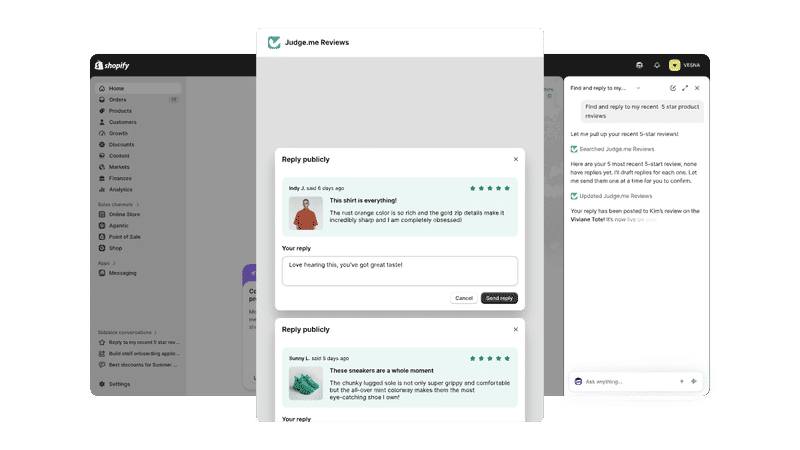
Shopify’s built-in AI assistant, Sidekick, can now deeply integrate with leading applications in the ecosystem. Starting initially with popular solutions like Judge.me, Klaviyo, Loop, and Smile, this support allows Sidekick to not only answer your questions about application data in your store but also take actions and perform operations on your behalf directly within these applications.
- You can give commands to Sidekick like “Optimize the last abandoned cart scenario in Klaviyo” or “Update the loyalty point limits on Smile” to start managing your operational processes completely through AI.
Start the Day with Tips via Sidekick
Every time you open your Shopify admin panel, Sidekick greets you with strategic tips specific to your store. The AI assistant lays out directly applicable advice focused on acquiring new customers, optimizing conversion rates, and ensuring repeat sales from your existing customers.
Quick Task Clarification with Sidekick
The era of writing long descriptions when communicating with Sidekick is over. The AI assistant will offer you smart options when it needs additional information to fulfill your command. In this way, you will be able to clarify the action you want to take within seconds just by clicking the right option on the screen and initiate the autonomous process.
Apps Generated by Sidekick
A brand-new editor interface is now available for in-store apps and interfaces generated or customized by Sidekick. You can now directly edit the code within Sidekick’s integrated app editor, preview changes in real-time on both desktop and mobile screens, and most importantly, securely track the version history throughout the entire process.
Shopify Flow Testing with Sidekick
Testing your workflows on Shopify Flow before going live is now much easier. Sidekick can generate AI-powered test events in the background to validate the automation logic you have set up. This allows you to simulate whether your logical steps work flawlessly without putting your store at risk.
Online
AI-Powered Sales Representative with Shopify Inbox
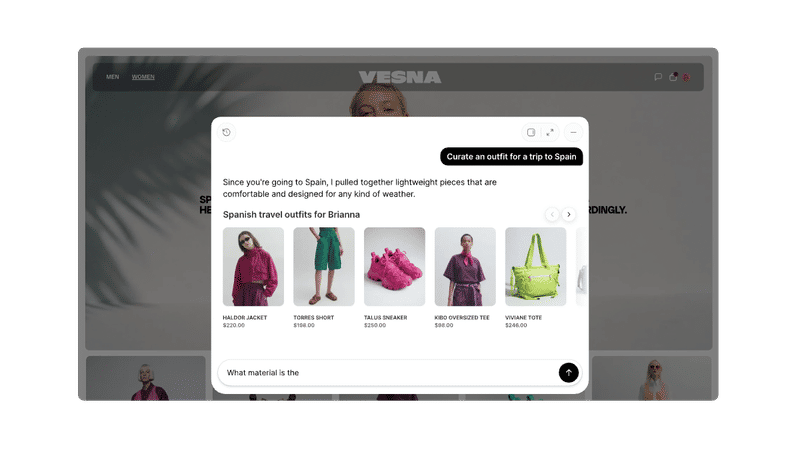
Shopify’s built-in messaging app, Shopify Inbox, now transforms into a smart AI sales representative working 24/7 in your store. Moreover, it remembers loyal customers who have logged into the system with Shop accounts, analyzes their past shopping and browsing habits, and can offer completely personalized, point-on product recommendations within the chat window.
In-Store Search Experience Is Now Smarter
Shopify’s built-in search engine infrastructure is now much more flexible and smart. Even if visitors to your store make typos in the search box, misorder words, or use unusual expressions belonging to colloquial language, the system lists the most accurate and relevant product results for them thanks to intent-based matching in the background.
Customer Experience Simulation on Themes with SimGym
Shopify announced the SimGym infrastructure, a game-changer in store optimization. Thanks to this feature, you can have any of your live or draft themes tested by AI-simulated shoppers. While navigating your store, AI agents analyze the friction, user experience (UX) errors, and cart abandonment tendencies they encounter, providing you with directly applicable development ideas.
- If you plan to switch to a new theme or make a radical interface change, instead of putting it in front of real users and risking the conversion rate, you can test it with SimGym virtual customers first to close potential design flaws at zero cost.
- By running SimGym analyses at regular intervals in your store, you can detect the weak points of your site through the eyes of different customer personas (for example, a rushed mobile user or a desktop visitor stuck at the cart step) and make conversion rate optimization (CRO) autonomous.
A/B Testing with Shopify Rollouts
Shopify announced the new Rollouts infrastructure, which will end dependence on complex third-party software. Thanks to this feature, you can publish a new theme, checkout customizations, or new customer account configurations by scheduling them for a later date, or you can run them directly as a built-in A/B test by splitting the incoming traffic.
Additionally, you can easily translate the theme you prepared according to the languages of your target markets, then schedule these localized designs to go live on a specific date using the Rollouts infrastructure, or present them directly as a special A/B test to visitors in that country.

Visualized Interface for Shopify Markets
A great visual update is coming for brands using Shopify Markets. Thanks to the new graph-based interface, you will be able to see a bird’s-eye view of which discounts are active in which market, which products are listed, and market-specific localization settings through a single central graph, easily making sense of complex international configurations.
Market-Focused Discounts and Promotions
With the new update, instead of just defining a general discount, you can design completely targeted promotions and campaigns specific to your customers in certain geographical areas (Shopify Markets), your physical retail stores (Shopify POS locations), or your wholesale (B2B) channels.
Management of Legal Compliance and Product Warnings (Compliance)
A critical update is coming, especially for brands selling in regulated industries. You can now define legally mandatory warnings such as safety, health, or age restrictions (compliance disclosures) for your products directly from the Shopify panel. These warnings are automatically and synchronously displayed to the customer not only in your online store but also on AI channels and the Shop app.

Refreshed Customer Pages
Shopify has brought a modern and fully customizable structure to customer account pages, which had remained standard for a long time. Next-generation account pages offer user-friendly intuitive navigation, branded sign-in screens reflecting your brand’s identity, and most importantly, smart AI-powered product recommendations to capture customers who have just become members or placed their first order.

Dynamic Pricing with Shopify Smart Pricing
Shopify announced the Smart Pricing App, which will increase profitability and competitiveness in e-commerce. This smart infrastructure analyzes your store’s past sales performance, real-time inventory levels, product costs, and market seasonality with AI, offering the most optimized pricing strategies and tips that you can apply directly on a product basis.
B2B Features Now Included in More Shopify Plans
Shopify is moving its powerful B2B (wholesale) infrastructure, previously offered only in top-tier plans, to lower packages as well. Now, without paying an additional fee, you can create corporate company profiles, define volume pricing rules, and manage your wholesale operations directly by assigning up to 3 specific B2B catalogs to different customer groups through your admin panel.

Shopify Collective
Shopify takes the Shopify Collective infrastructure, which brings together independent sellers and suppliers in the ecosystem, to a much stronger level in terms of both functionality and financial management. Expanding your store’s inventory network without risk is now much easier with next-generation sourcing, smart tax management, and advanced discovery tools.
- Data-Driven Smart Product Sourcing: You can see empty search results and instantaneous audience trends of your target audience from a single dashboard. You can instantly identify products that your customers are looking for but cannot find on your site from suppliers in the Collective network and offer them for sale without taking inventory risk.
- Automatic Tax and Margin Protection in B2B Processes: In the tax-inclusive pricing model, B2B taxes belonging to corporate sales are automatically calculated by the system. Your net profitability and effective margins are directly protected without the need for manual calculation among complex tax scenarios.
- Enhanced Product Discovery and Fast Integration: Thanks to newly added category pills and advanced filtering options, you can find products suitable for your store within seconds. Moreover, even if the setup of your payment methods is not yet completed, you can save time by importing the products you like into your store as drafts in advance.
- Shipping Performance and the “Verified Tracking” Era: Suppliers in the system can now transparently monitor their own shipping performance directly from the dashboard. Suppliers who manage shipping processes flawlessly and show high performance earn a “Verified Tracking” badge, standing out in the system. This allows retailers to quickly find the most reliable business partners.
Marketing
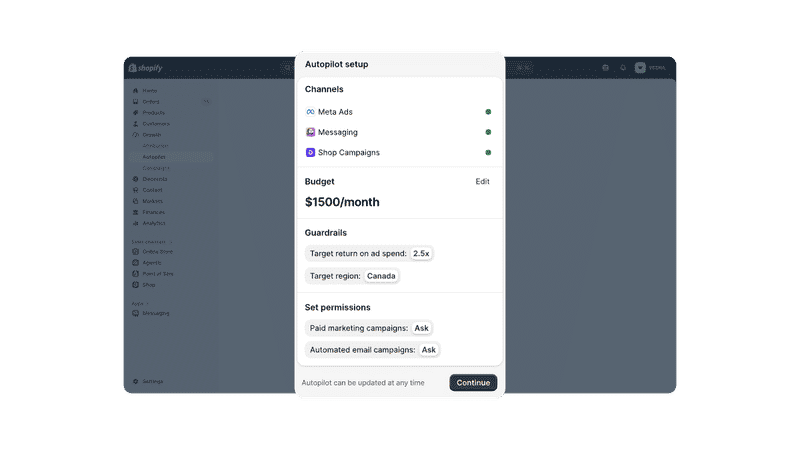
AI-Powered Marketing Era with “Campaign Autopilot”
Shopify announced the revolutionary new Campaign Autopilot feature for brands that want to manage their advertising and marketing budgets in the most effective way. This smart infrastructure runs your advertising processes across different marketing channels (social media, email, search engines) completely autonomously with AI support. As campaigns stay live, it learns your target audience’s behaviors, optimizes the budget instantly according to the channel bringing the highest conversion, and constantly pushes your advertising performance upward.

Transformation of Shopify Messaging into an Omnichannel Marketing Hub
Shopify transforms Shopify Messaging, its communication and marketing infrastructure, into an omnichannel marketing hub. Now you can manage email, SMS, and WhatsApp channels autonomously from a single dashboard, reaching your customers through the right channel at the right time.
- WhatsApp Marketing Directly from the Panel: Connect with your customers via WhatsApp, one of the channels with the highest open rates. Without needing a separate third-party integration, you can build WhatsApp marketing campaigns directly inside Shopify Messaging, delivering your new collection or discount announcements with personalized messages.
- Advanced SMS and Marketing Automations: You can now include SMS automations in trigger scenarios (cart abandonment, membership welcome, order tracking, etc.) in your store. By structuring email and SMS steps sequentially according to users’ habits, you can maximize the chance of conversion.
- Smart Delivery Infrastructure: The system applies smart filtering to avoid bombarding your customers with messages and turning them away from your brand (creating a spam perception). It prioritizes which message should be sent immediately and which should be held back or canceled using AI, optimizing directly according to the conversion rate.
Your Product Bundles Are Now Multi-Channel
- Direct Bundle Listing on Social Channels: Instead of just displaying the product bundles you configured in the panel on your online store; you can list and advertise them directly as a single package product on Google Shopping, YouTube, Facebook, and Instagram channels.
- Bundle Ads via Feed: Instead of highlighting a single product in Meta or Google ads, you can feed an advantageous bundle consisting of related products directly through the product feed as a single item, ensuring the customer comes to the site with a higher cart volume.
Plugins
AI Agents and “Vibe-Coding” Integrations
Shopify directly includes autonomous AI Agents and the “Vibe-Coding” movement, which enables software development with natural language commands, into its ecosystem.
- From Idea Stage to Live Store: Just by describing your business idea and brand vision, you can launch a working Shopify store within seconds via next-generation AI platforms like V0, Lovable, Replit, or Manus. The system codes the design and functional setup autonomously for you.
- Autonomous Store Management Inside Chatbots: The requirement to enter the Shopify panel to run your store operations is disappearing. By moving your store management inside Claude, ChatGPT, or Perplexity; you can add products, organize collections, and manage order processes from the chat interface just by giving commands to the AI (“Add the incoming red dress with its SKU”, “Create a collection for the summer season”).
- “Shopify AI Toolkit” for Developers: Developed for teams optimizing store architecture or producing custom solutions on the technical side, this toolkit integrates directly with AI-powered code editors such as Claude Code and Cursor. In this way, complex backend systems, theme developments, and API integrations can be managed end-to-end directly through AI platforms.
Admin Panel and Operations
Analytics and Advanced Data Visualization
Shopify has completely rewritten its analytics infrastructure, automatically making raw data interpretable and targetable.
- Next-Generation Advanced Chart Types: Advanced visualization tools such as scatter plots, radar charts, bubble charts, and sunbursts have been added to the panel for you to discover correlations and hidden patterns in data.
- Multi-Metric Comparison: You can catch trends instantly by listing multiple metrics simultaneously on line or bar charts (for example: the instantaneous correlation of ad spend with conversion rate).
- Autonomous Daily Insights: The system autonomously analyzes your data on the analytics summary screen, automatically surfacing the most critical trends or anomalies prominent that day.
- Automatic and Manual Chart Annotations: Visual markers added onto charts facilitate retrospective data tracking by explaining why metrics changed that day (for example: “X campaign started” or “Server error occurred”).
- Instant Metric Targets: You can set targets for your key metrics (KPIs) and visualize instantly how close you are to these targets via charts.
- Customized Reports with Metafield Filtering: You can filter and group your analytical reports directly according to your own structured data (metafields) assigned to your products or orders.
Optimized Metafields Processes
- Creating Metafields During Workflow: While operating on customer, order, or collection pages, you can define new metafields directly within the workflow (context) you are in, without leaving the current page to go to settings.
- Pinned Metafield Support Up to 50: You can pin up to 50 of your most frequently used metafields to the top of the page on product, customer, and order detail pages without the requirement to click a separate tab.
Finance, Store Management, and Operations
- Flexible Discount Definition on the Refund Screen: You can apply discounts directly through the refund screen. The system keeps turnover, tax, and financial reporting perfectly balanced and legally compliant in the background.
- Centralized and Consistent Pricing Engine: The price calculation architecture in returns and upsells has been aligned exactly with the checkout logic. This completely prevents penny financial discrepancies between channels.
- Dynamic Category-Based Return Reasons: Whether your customers make returns from the online store or physical POS, return reasons are now listed dynamically, specific to the category of the product they purchased.
- App Visibility Log: You can monitor what installed applications in your store are doing in the background, which extensions and functions they trigger, and what data they access from a transparent log screen.
- Line-Item Custom Pricing in Draft Orders: While creating draft orders, you can override standard product prices and assign custom discounts directly on a line-item basis.
- Central Search, Filtering, and Smart Views: You can search and filter across the panel through a single search bar, and quickly access your frequently used views by saving them.
Shopify Flow and Advanced Automation
- Advanced Code Editor Inside Flow: An integrated code editor has been added inside Shopify Flow for Liquid variables and script writing. Thanks to syntax highlighting, autocomplete, and code formatting features, you can write in-flow customizations much faster.
- Automatic Shipping Label Purchase: When defined triggers occur (for example: “When an order from supplier X is approved”), you can trigger automatic shipping label purchases through Shopify Flow rules.
- Version History and Flow Notes: You can retrospectively track who updated an automation flow and when (version history), and leave explanatory notes specific to your team on Flow steps.
- Codeless ShopifyQL and API Access: You can access ShopifyQL data and advanced Admin API fields directly from within Shopify Flow automations without any API integration or code-writing requirements.
Inventory
Multi-Location Advanced Inventory and Warehouse Management
- Single SKU Sharing Across Locations: You can list the same product variant across multiple physical locations or warehouses without needing to duplicate the inventory card. This allows you to work with a clean, centralized, and unique SKU architecture.
- Multi-Source Store Pickup (Click & Collect): While preparing pickup orders that customers will collect from the store, you are not dependent only on that store’s instant stock. You can complete delivery processes flexibly by assigning inventory transferred from other warehouses to the order as well.
- Barcode Scanning at Shipment Level (GS1-128 Support): In inventory transfers between warehouses or incoming shipments, you can perform receiving processes at maximum speed by scanning advanced shipment barcodes such as GS1-128 directly through the panel.
- Inventory Management Independent of Sales Status: You can carry out moving, counting, or organizing your stocks among your physical locations completely independent of whether that product is actively on sale in online channels.
- Stock Adjustment Workflows with Audit Trail: While updating or syncing stock quantities, a complete retrospective audit trail showing which user made each change and for what reason is kept in the background.
- Instant Stock Sync in High Traffic: Thanks to infrastructure improvements, updated quantities of back-in-stock products during flash sale days or major launch moments (high-traffic events) are now reflected instantly in your online store.
Smart Sourcing and Purchasing with Sidekick (AI)
Shopify’s AI assistant Sidekick no longer just organizes interfaces; it is directly included in your background operations and procurement decisions.
- Predictive Procurement Analytics: Sidekick analyzes your past sales velocity, seasonal trends, and inventory cycles to offer data-driven smart insights regarding when and how much you should order from which product.
- Autonomous Purchase Orders: You can create purchase orders (POs) for your suppliers with natural language commands you give to Sidekick. The moment these orders are approved, they automatically transform into warehouse transfer documents (transfers) in the system.
Smart Return Analytics and Customer Self-Service Cancellation Process
- Self-Service Cancellation and Return from the Order Status Page: Your customers can send cancellation requests directly through the order status page before their orders are shipped, or start a self-service return process after the shipment arrives. This minimizes the operational load on your support team.
- Categorized Return Data Analytics: Every product returned to the store matches with return reasons and transforms into analytical data in the system. Thus, you can proactively optimize product quality or site product descriptions by seeing which product was returned due to which chronic problem.
Shipping & Logistics
In-Warehouse Operation and Order Fulfillment
- Batch Fulfillment Workflow: You can group your orders into batches and run a picking, packing, scanning, and shipping workflow that is fully customizable according to the physical structure of your warehouse.
- Advanced Local Pickup Notifications: You can manually re-trigger local pickup emails from the admin panel or ensure they are sent automatically via the Shopify API through the applications you use.
- Automatic Carrier Detection: When a tracking number is manually entered into the order, the system automatically recognizes the carrier from the format of the tracking number and matches it with the correct carrier.
Advanced Shipping Options and Carrier Integrations
- Hybrid Shipping Conditions (Advanced Shipping Options): You can define flexible rules by combining both cart total and package weight criteria simultaneously under a single shipping option, adding specific descriptions and estimated delivery times to the checkout step.
- FedEx Integration for Managed Markets: Within the scope of Shopify’s global sales solution Managed Markets, you can ship internationally with prepaid duties using FedEx International Connect Plus®.
- DHL Kleinpaket for Germany: The DHL Kleinpaket infrastructure, which is a much more economical alternative for light package shipments under 1 kg to be made from your warehouses in Germany, has been directly integrated.
- Pay-As-You-Go UPS Return Labels (US): Businesses in the US can purchase UPS return labels from the panel and send them to their customers, paying the fee for this label only if the customer ships the package (if the label is used).
- Shipping Label Billing in Local Currency: You can directly pay the fees of the shipping labels you purchase in CAD, EUR, GBP, or your own local currency without being exposed to any currency conversion fees.
Payments
Shop Pay and Global Payment Methods
- Shop Pay Opened to the Entire Internet (Platform Agnostic): Shop Pay, the most powerful conversion tool of the Shopify ecosystem, has now opened to the integration of all platforms using non-Shopify infrastructure (Custom, Magento, WooCommerce, etc.). More than 250 million ready buyers can now make secure one-click purchases on every website.
- Dynamic Payment Methods (Managed Payment Methods): Shopify Payments dynamically ranks alternative payment methods on the checkout page according to each customer’s past habits and location, pushing the option with the highest conversion probability to the top.
- Local Payment Methods Inside Shop Pay: For brands selling on a global scale, the Shop Pay wallet now natively supports local and regional payment methods within itself.
- Shopify Payments in the UAE: Shopify Payments has now been activated for businesses in the United Arab Emirates (exclusive to Shopify Plus).
- Multi-Entity and Multi-Currency Management: Brands with multiple legal entities in the same country can run their operations by connecting different Shopify Payments accounts from a single store, transferring payouts directly to their accounts in local currencies without conversion fees.
Renewed and Conversion-Oriented Checkout
- Mobile-Focused New Design: The checkout interface has been made more compact, minimizing scrolling actions on mobile devices. Delivery options have been optimized, and the “Pay Now” button has been moved up, increasing conversion rates.
- Shipping and Store Pickup in the Same Cart (Ship and Pick up): Customers can now check out by selecting both “shipping to address” and “store pickup” options simultaneously for different products in a single order.
- Live VAT Validation for EU and UK (VAT ID): The Shopify Tax infrastructure validates and records the VAT IDs of corporate buyers in the EU and UK live during checkout.
- Advanced Address Validation and Cart Limits: While address autocomplete speed is increased for customers in the US, Canada, Australia, France, and the Netherlands; minimum/maximum cart subtotal limitations and address format requirements have been made configurable across all plans.
- Centralized Corporate Identity Application: When you define your logo, colors, and typography once in the panel, this corporate identity is automatically and consistently reflected in the checkout, customer account pages, and sign-in screens.
- Advanced Mobile Sales and Payment Links: Features such as collecting tips, calculating change, adding shipping fees, and sending an instant payment link directly to the customer have been added to the Quick Sale interface, which enables fast sales through the Shopify mobile app.
Development Tools and APIs
AI (AI, Agents & Vibe-Coding) Development Tools
- Built-in Commerce Skills for AI Agents: Claude Code, Cursor, and other popular AI platforms have gained built-in commerce skills that you can directly use to design, code, and manage Shopify storefronts, themes, and applications.
- Optimized Shopify Dev MCP: The Shopify Dev MCP used when developing with AI models has been optimized to consume much fewer tokens, preventing context windows from bloating. Moreover, full code validation and error-free context transfer for all supported Shopify API versions are now natively offered within the MCP.
- Autonomous Polaris Web Component Transformation: You can upgrade your checkout and new customer account extensions directly to the Polaris Web Components infrastructure autonomously and smoothly via your preferred AI agent and the Shopify AI Toolkit.

API, Webhook, CLI, and Performance Optimizations
- Smart Webhook Filters and Custom Payload Support: You can now filter webhook triggers to fire only when specific fields change. Moreover, thanks to custom GraphQL queries, you can minimize your server costs and load by calling only the data you need via the webhook payload.
- 4x Speed in Bulk Queries (Parallel Reads): Bulk data retrieval operations on the Admin API now finish up to 4 times faster thanks to the new parallel reads architecture.
- Agent-Based and Automated GraphQL Queries via CLI: You can trigger bulk operations and GraphQL queries autonomously from the terminal or from within AI Agents using the Shopify CLI. The system runs seamlessly with automatic authentication (auth) and built-in status tracking.
- Simplified Metafields & Metaobjects API: Metaobjects and metafields management processes have received a brand new GraphQL API architecture that is much more flexible, performant, and developer-friendly.
- Direct Metafield Support Inside ShopifyQL: While analyzing in the Analytics API and reporting tools, you can call metafield data directly as a dimension or filter using dot-notation (metafields.namespace.key) architecture.
Application (App) and Function (Shopify Functions) Development
- No-Backend Era for Lightweight Apps: You can now build App Home pages that can work natively directly inside Shopify Admin without dealing with external backend server setup, scaling, and maintenance costs.
- Secure CI/CD App Deployment (Safer Deployments): You can configure isolated, stable, and secure CI/CD deployment pipelines that completely eliminate the risk of accidentally deleting existing extensions actively working in live stores.
- Metaobject Support in Checkout Functions: You can read metaobject data instantly directly within Shopify Functions to configure custom discounts, advanced product rules, and personalized checkout logics.
- Billing Address and PO Number Querying in B2B Validations: To automate B2B workflows and legal compliance processes, you can now query the billing address and purchase order number (PO number) directly in cart and checkout validation functions.
- Fast Payment Support for Add-on Products: Nested cart lines support has come to fast payment systems like Shop Pay and Apple Pay. Thus, customers can instantly purchase additional offers (add-ons) on the product page directly with the fast payment flow.
- In-App Conditional Discount Configurations: Admin UI Extension tools can now directly manage discount classes, rendering dynamic, conditional interfaces in the admin panel according to the selected discount method and rules.
- No-Scope Declarative Metaobjects: App-owned metaobjects no longer require extra API scope authorization; this way, data migration processes are completed completely smoothly the moment the app is installed.
New Partner Panel and Developer Control Center (Dev Dashboard)
- All Stores Under One Roof (Dev Dashboard): Development, client transfer, and collaborator stores are all now uniting under the new Dev Dashboard; this becomes the new center of project management.
- App Events API and Live Performance Analysis: You can transfer your in-app events directly to Shopify, and monitor your app’s web vitals performance on the admin side and its compliance status with Built for Shopify standards live through the panel.
- Advanced Webhook Monitoring: Monitoring webhook health and data flow is now much easier with multi-filtering, categorized event counts, and custom time range support.
- Automation Tokens for CI/CD: You can generate App Automation Tokens directly through the panel to autonomously trigger app releases in continuous integration (CI/CD) workflows.
- Role-Based Partner Management (RBAC): While managing your partner team, you can utilize 7 standard system roles or define completely flexible, customized roles specific to your workflow.
- Renewed Polaris Documentation: All reference documents belonging to the Polaris design system have been completely updated with rich code examples, clear usage scenarios, and a new optimized navigation structure.
App Revenue Models, Security, and Store Processes
- Simplified App Pricing (Shopify App Pricing): You can now configure your app plans through the panel with usage-based, recurring, or hybrid pricing models while submitting them to the App Store. All approval and billing processes are managed natively by the Shopify infrastructure.
- Advanced App Security (OAuth 2.0): For public apps, expiring tokens and refresh flows compliant with OAuth 2.0 standards have been made mandatory, raising store and app security to the highest level.
- Network Error Protected Inventory API (Idempotency): Thanks to the idempotency support added to the Inventory API, repeated (retried) API requests due to network outages are completely prevented from causing duplicate stock records or data errors.
- Streamlined App Submission: With new built-in checks integrated into the Partner Dashboard, you can instantly catch potential errors before submitting your app for review, and track the review team’s feedback instantly directly through the panel without dealing with email chains.

Advanced Checkout, Themes, and Metafields
- Unified Branding API for Checkout and Accounts: Thanks to the renewed Branding API, you can now manage corporate identity designs of checkout, customer accounts, and sign-in pages (from global settings to page-specific details) end-to-end through a single centralized API.
- AI-Powered Checkout Extension Audit: The new optimization layer coming to the Shopify AI Toolkit instantly audits the checkout UI extensions you developed in terms of performance, offering point-on recommendations to minimize loading times.
- New Color Palette Structure for Themes: A brand new structure has been designed in the settings area of themes, allowing the definition of centralized color palettes that can be called dynamically throughout the entire theme.
- Bulk Edit Extensions for Discounts: With the new bulk action extension support coming to the discount management panel, you can build solutions that will enable merchants to manage hundreds of discounts through a single panel at one time.
Next-Generation Hydrogen and Storefront Standards
- Completely New Hydrogen Compatible with Every Stack: Rewritten from scratch as agent-first in partnership with Vercel, the next-generation Hydrogen now surpasses Remix boundaries, starting a brand new era that provides smooth integration with any JavaScript framework you desire, including Next.js.
- Standard Storefront Events and Actions: New standardized event and action sets for in-store interactions have been made available. Thanks to this standard, external applications and AI Agents can now interact with the site interface and cart processes much more stably and with zero errors.
- Multi-Channel Sales Application Support: A multi-connection architecture has been adopted in Sales Channel applications. You can now flexibly configure multiple independent channel connections serving different surfaces, requirements, or accounts within the same application.
Customer Accounts and the Shop Ecosystem
- Built-In Update of Subscription Payment Methods: Thanks to customer account UI extensions, users can instantly update payment methods belonging to their subscriptions directly within their own account dashboards without being redirected to an external page.
- One-Click Sign-In with Shop (SDK & API): With the newly developed SDK and Shop APIs, you can enable customers to log into your store or application securely with a single click (one-tap) using their Shop accounts.
- Email Pre-definition on the Sign-In Page: With the new login_hint support, you can speed up the user experience by ensuring customers’ email addresses come pre-filled in the form field when redirecting them to the sign-in page.
- Customer Account Web Component: A new high-performance Web Component tool embedded in the Shopify architecture, allowing users to log in and access membership menus without leaving the site, has been made available.
Conclusion
Shopify Editions Spring 2026 makes one thing incredibly clear: the future of e-commerce is highly automated, deeply integrated, and un-siloed. By embedding native AI infrastructure directly into the catalog level, unlocking Shop Pay for non-Shopify platforms, and giving developers headless control over every commerce surface, Shopify is making it easier than ever to build frictionless customer experiences.
Whether you are looking to optimize your storefront conversion through AI simulations like SimGym, expand into new wholesale markets with B2B, or streamline your app development workflows using the Shopify AI Toolkit, this release offers an entirely new playbook for growth.